

Part 1 of 4: Building Business Identity and Purpose
Every morning, millions of people wake up and go to work for companies that struggle to answer a simple question: “Why do we exist?” They can answer “What do we sell?” or “How do we make money?” but the deeper, more fundamental question of purpose that drives everything else (leadership, marketing and sales, customer engagement, employee satisfaction, even innovation) is missing.
Some companies cobble together a mission statement or a vision statement, only to find them uninspiring to the employees and put them in the background. Simply put, they miss the mark. “We want to be a billion-dollar company by 20xx”. Is that your higher purpose? Do your employees wake up in the morning and say, “I want to go to work so my company can become a billion-dollar company?” I doubt it, unless they are flush with stock options.
One of the latest trends is giving a percentage of profits to an environmental fund. Don’t get me wrong, that’s a noble cause with all the forest fires, drought, and food shortages around the world. But is it an authentic purpose for your business, or are you just doing it because it’s fashionable or your customers demand it?
We see the effects of an inauthentic purpose in businesses all around us. Small companies fumble around directionless and ultimately close their doors. Larger companies try to rely on existing customers to carry them through the mounting chaos as employees start watching the quarterly results to see if layoffs might be looming. Once-innovative products become commodities and compete only on price. Customers come and go. So what’s a company to do?
Simon Sinek’s groundbreaking concept of “Start With Why” gets to the root of the problem – uncovering the authentic purpose of the company. It’s a fundamental shift in how we think about business success. When companies discover and articulate their basic purpose, or “Why”, before looking at the value proposition or products/services, they transform from commodity providers into movements that people want to join, support, and remain loyal to for decades.
Understanding the Golden Circle
Simon Sinek’s “Why” is based on the concept of the Golden Circle, which consists of three concentric layers:
- The “What”: The outermost layer, representing what an organisation does. These are the products they sell or the services they offer.
- The “How”: The middle layer, explaining how an organisation’s products or services are different or better than others. This layer includes their unique selling proposition or process.
- The “Why”: The innermost layer, representing the core belief, purpose, or cause that drives an organisation. It’s the reason why they exist, beyond just making a profit. This layer is the starting point for inspirational leaders and companies.
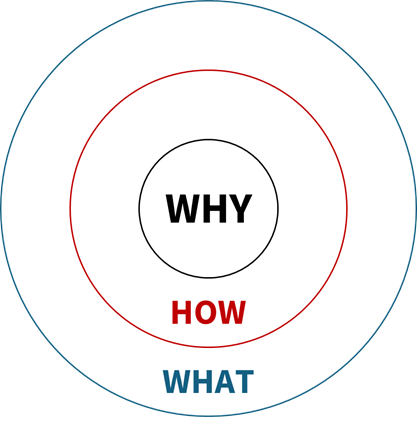
Figure 1 – The Golden Circle
According to Sinek, most organisations look at defining and communicating their business the wrong way. They work from the outside in: they start with what they do, sometimes mention how they do it, and rarely touch on why they do it. The most inspiring and successful organisations communicate from the inside out, starting with “Why”.
Compare these two approaches:
- When a company says, “We make computers (what). They’re beautifully designed and user-friendly (how). Want to buy one?” they’re starting with “What”.
- We believe in challenging the status quo and thinking differently (why first). Our products are beautifully designed and user-friendly (how). We happen to make computers (what). Want to buy one?”
The second approach starts with “Why”, the company’s purpose, and it’s precisely how Apple has communicated since the 1990s when they introduced the “Think Different” motto.
You might think the difference is insignificant. Neurologically, however, there is a change in which part of the brain is used when we start by communicating the why. We’re speaking to the limbic part of the brain responsible for feelings, trust, and decision-making. This part of the brain is associated with buying and emotionally remaining loyal to a brand. When we start with “What”, we only engage the neocortex, which processes rational thought but doesn’t drive behaviour. As we’ll see, Apple masterfully incorporated their purpose of “Think different” into everything they have made and has led to a robust, loyal customer base.
Why “Why” Matters for Business Identity
Let’s be clear – your “Why” isn’t your mission statement or your value proposition. It’s the fundamental belief that drives your organisation’s existence. It’s the reason you get out of bed in the morning, beyond making money. Companies with clear “Whys” don’t just have customers, they have believers who become advocates, employees who become ambassadors, and partnerships that feel like natural extensions of their purpose.
Every organisation should have one, and only one, “Why”. There could be many “How’s” and “What’s” but always one core, foundational, purpose.
If we look at successful company web pages, mission statements, vision statements, leadership quotes, and company results reports, we can begin to formulate their “Why”, “How”, and “What”. Oftentimes, they state outright their root purpose and how they distinguish themselves from other companies.
Consider Patagonia’s “Why”: “We’re in business to save our home planet.” This statement isn’t about selling outdoor gear; it’s about environmental activism. Everything they do, from their products to their marketing to their corporate policies, flows from this central belief. Their customers don’t just buy jackets; they join a movement.
Or look at Southwest Airlines, whose “Why” centres on democratising air travel. They make flights accessible to everyone, not just the wealthy. This belief shaped everything from their no-frills service model to their employee culture of treating every passenger like family.
A Closer Look at Apple
Apple is an excellent example of how a clear purpose was instilled into the company culture from the 1990s. Steve Jobs returned to Apple and helped breathe new life into a company weeks away from bankruptcy. What did they do?
Jobs worked with several marketing teams to rebrand Apple. Ultimately, they settled on a simple campaign centred around the motto “Think Different”. The wording was significant. He didn’t want to use “Think Differently” and instead, use different as a noun. This product that we will make is different. Jobs was banking on customers wanting something they hadn’t seen elsewhere. They wouldn’t compete on price, making a cheaper version of someone else’s product. Apple was to challenge the status quo in every product it made.
Applying Simon Sinek’s Golden Circle, Apple was revolutionising their company right from their authentic purpose. All media, internal and external communications, hiring, training, and so on were driven by this why. The why drove the how. The how drove the what.
The “Why” (The Core Belief): We believe in challenging the status quo.
The “How” (The Differentiator): By meticulously designing elegant, intuitive, and easy-to-use products that combine hardware, software, and services seamlessly to create a unified experience.
The “What” (The Product/Service): We make computers (Mac), phones (iPhone), tablets (iPad), watches (Apple Watch), and a variety of software and services.
The “What Leads to Why”: A belief in the power of the individual. Apple’s “why” is not just about technology; it’s about giving people the ability to create, connect, and express themselves in a way that feels natural and empowering.
Let’s look at a few Apple products and see how they challenge the status quo.
1. The Mac (Computers)
- Challenging the Status Quo: In the early days, the status quo was command-line interfaces and complex, technical computing. The Mac challenged this by introducing a graphical user interface (GUI) with a mouse, making computing accessible and intuitive for the average person. This move was a direct challenge to the industry’s focus on technical prowess and complex systems. The Mac’s “why” response was to democratise computing and put a powerful, user-friendly tool in the hands of creative individuals. This legacy continues today with a focus on seamless integration of hardware and software, security, and elegant design, differentiating it from the more fragmented PC market.
2. The iPhone (Phones)
- Challenging the Status Quo: Before the iPhone, the status quo was a phone with a physical keypad and a limited, often clumsy, operating system. The iPhone completely reinvented the mobile phone. It did so by introducing a multi-touch interface, a full web browser, and the App Store. The iPhone wasn’t just a new phone; it was a pocket-sized computer that fundamentally changed how we communicate, work, and consume media. The iPhone’s “why” response was to create a device that was more than just a phone; it was a powerful extension of the user’s creativity and connectivity.
3. The iPad (Tablets)
- Challenging the Status Quo: The tablet market existed before the iPad, but it was filled mainly with bulky, expensive devices that were little more than laptops without keyboards. The iPad challenged this by creating a new category of device that was ultra-portable, intuitive to use, and focused on content consumption and creation. It wasn’t trying to replace a laptop; it was redefining what a mobile computing device could be. The iPad’s “why” response was to provide a flexible, in-between device that was more capable than a phone but more immediate and personal than a computer, challenging the traditional hierarchy of computing devices.
4. The Apple Watch (Wearable Tech)
- Challenging the Status Quo: The status quo for watches was either a simple time-telling device or a basic fitness tracker. The Apple Watch challenged this by reinventing the wrist as a hub for health, fitness, and seamless communication. It went beyond just tracking steps to offering features like heart rate monitoring, fall detection, and an integrated system for managing calls and notifications. The Apple Watch’s “why” response was to make a wearable device that was not just a gadget, but a tool for a healthier, more connected life, deeply integrated into the user’s daily routine.
The Challenge of Discovering Your Authentic “Why”
Here’s where many businesses stumble: they try to manufacture a “Why” that sounds good rather than discovering the “Why” that drives them. Authentic “Why” discovery requires honest introspection and often reveals uncomfortable truths about what’s motivating your organisation.
Your “Why” might not be noble or world-changing, and that’s okay. A family restaurant’s “Why” might be “bringing people together over comfort food that reminds them of home.” An accounting firm’s “Why” might be “giving small business owners peace of mind so they can focus on what they love.” These aren’t grandiose purposes, but they’re authentic and meaningful to the people they serve.
The key is authenticity over aspiration. A “Why” that sounds impressive, but doesn’t reflect your actual beliefs, will feel hollow to employees and customers alike. People have an intuitive sense for authenticity, and they’ll sense the disconnect between what you say and what you truly believe.
Practical Steps to Uncover Your “Why”
Start by examining your origin story. Why was your company founded? Not the sanitised version in your corporate history, but the real reason. What problem kept the founders up at night? What injustice or inefficiency made them say, “There has to be a better way”?
Look at your most passionate employees and customers. What draws them to your organisation? What do they say when they recommend you to others? Often, they’ll articulate your “Why” better than you can because they experience it as outsiders.
Examine your decision-making patterns. When you’re forced to choose between profit and principle, what do you choose? When you’re deciding between two equally viable options, what criteria do you use? These moments reveal your actual values and beliefs.
Consider your emotional reactions to competitors and industry practices. What makes you angry or frustrated about how things are done in your industry? What gives you energy and excitement when you think about changing it? These emotional responses often point toward your “Why”.
Huvaso’s “Why”
Let’s look at an actual example. When I started Huvaso, I thought long and hard about the mission statement and values. I would struggle to put my thoughts on paper and come up with something authentic. What I ultimately came up with was:
Mission Statement: To provide small to medium-sized technology companies with the knowledge and frameworks they need to deliver quality products and achieve sustainable growth efficiently.
This statement clearly defines what Huvaso would do (provides knowledge and frameworks), who it serves (small to medium-sized technology companies), and the ultimate goal of its work (efficient delivery, quality products, and sustainable growth).
What it lacked was the core belief behind all the standard business statements. It lacked the fundamental purpose for Huvaso, its entity, its “Why”. When I approached it from the “Why” perspective first, everything clicked. From the “Why” flowed the “How”, the “What”, a vision statement, and values. The following is what I came up with:
The “Why” (The Core Belief): We believe that disciplined project management is the engine of innovation and the foundation for creating sustainable value for every technology company.
- Explanation: This statement articulates the core belief that structure, discipline, and best practices are not inhibitors of creativity, but rather the very fuel that drives innovation and long-term success. It encapsulated my purpose in starting Huvaso in the first place.
The “How” (The Differentiator): By offering intensive 1-2 week, hands-on workshops and training packages built on a foundation of industry best practices (e.g. PMI PMBOK), disciplined agile, value stream management, disciplined entrepreneurship, risk management, and the selective use of AI.
- Explanation: This “how” is the specific methodology and strategy Huvaso uses to prove its “why” is true. It shows how the company implements disciplined project management that enables innovation.
The “What” (The Product/Service): We offer 1-2 week workshop and training packages with a base price of $1500 per person per week.
- Explanation: This is the tangible product that serves as the vehicle for the “how” and the “why.” Note that how much money we hope to make is never a part of these statements. Even though we say how much a training package will sell for, we don’t quantify our financial goals with statements like “We plan to make $1,000,000 in the first year. An essential point in Simon Sinek’s approach is to focus on the purpose of your existence, how you will stand out, and what you plan to offer.
The “Why”, “How”, and “What”, combined with the mission statement, led to Huvaso’s core values:
Value Statement:
- Integrity: We act with honesty and transparency, building trust with our clients and stakeholders through every interaction.
- Empowerment: We equip our clients with the skills and confidence to lead their projects to success, fostering self-sufficiency rather than dependence.
- Excellence: We are committed to providing the highest quality training, based on proven methodologies and continuous learning.
- Practicality: We deliver actionable, real-world solutions that our clients can implement immediately to see tangible results.
- Innovation: We embrace modern techniques and technologies, including the selective use of AI, to keep our offerings relevant and practical in a rapidly changing world.
Finally, the Huvaso vision statement:
Vision Statement: To be the most trusted and sought-after partner for small to medium-sized technology companies seeking to transform their product delivery and build a culture of excellence.
- This statement is a forward-looking, aspirational goal. It defines what Huvaso wants to become in the long term: the premier partner in a specific market segment. It’s the ultimate destination of the company’s journey.
The “Why” as North Star
Once you’ve identified your authentic “Why”, it becomes your North Star for every business decision. Your hiring decisions become easier, and you look for people who share your beliefs, not just people with the right skills. Product development becomes clearer. You create solutions that advance your cause, not just things that might sell. Marketing becomes more authentic, and you attract people who share your beliefs, not just people who need what you sell.
Your “Why” also becomes a filter for opportunities. Does this partnership advance our “Why”? Does this new market align with our beliefs? Does this strategy help us fulfil our purpose? When you have a clear “Why”, saying no becomes as important as saying yes, because not every opportunity is the right opportunity for your specific mission.
Building Foundation for What’s Next
Understanding your “Why” is just the beginning of building an authentic business identity. It provides the foundation, but foundations need structures built upon them. In our next post, we’ll explore how Clayton Christensen’s Jobs-to-be-Done framework helps you understand not just why you exist, but specifically what job your customers are hiring you to do in their lives.
Your “Why” gives you purpose, but JTBD gives you precision – the ability to see precisely how your purpose translates into value for the people you serve. Together, they create a powerful clarity about both your mission and your market.
Remember, discovering your “Why” isn’t a one-time exercise. As your business evolves and grows, you may need to revisit and refine your understanding of what truly drives you. The goal isn’t perfection, it’s authentic clarity that guides your decisions and inspires your people.
Note: Grammarly was used to edit this document for correctness. Not all recommendations were necessarily used.
Coming Next: Part 2 – Jobs-to-be-Done: Understanding What Your Customers Hire You For
References
- Apple. Think Different [Advertising campaign]; 1997. Accessed August 8, 2025. https://youtu.be/5sMBhDv4sik
- Damasio AR. Descartes’ Error: Emotion, Reason, and the Human Brain. Putnam; 1994.
- Gallup. State of the Global Workplace. Published 2025. Accessed August 8, 2025. https://www.gallup.com/workplace/349484/state-of-the-global-workplace.aspx
- HBR Analytic Services. The Business Case for Purpose. Harvard Business Review; 2015.
- Isaacson W. Steve Jobs. Simon & Schuster; 2011.
- Joly H. Creating a Meaningful Corporate Purpose. Harvard Business Review; 2021
- Keller KL. Strategic Brand Management. 4th ed. Pearson Education; 2013.
- McKinsey & Company. Purpose: Shifting from why to how. Published 2020. Accessed August 8, 2025. https://www.mckinsey.com/capabilities/people-and-organizational-performance/our-insights/purpose-shifting-from-why-to-how
- Patagonia. Business Unusual. Accessed August 8, 2025. https://www.patagonia.com/business-unusual/
- Sinek S. Start with Why: How Great Leaders Inspire Everyone to Take Action. Portfolio/Penguin; 2009.
- Sinek S. How great leaders inspire action. TED. Published September 2009. Accessed August 8, 2025. https://www.ted.com/talks/simon_sinek_how_great_leaders_inspire_action
- Sinek S, Mead D, Docker S. Find Your Why: A Practical Guide for Discovering Purpose for You and Your Team. Portfolio/Penguin; 2017.
- Southwest Airlines. Our People and Culture. Accessed August 8, 2025. https://www.southwest.com/citizenship/people/
- Zaleznik A. Managers and leaders: are they different? Harvard Business Review 1977;55(3):67-78.